
The Psychology of Scrolling Past
Why Great Content Gets Ignored and Average Content Goes Viral
Introduction
A friend of mine runs a small bakery out of her home.
No team. No content calendar. No strategy meetings. Just her, her oven, and whatever energy she has left at the end of a long day.
One night she had a terrible baking session. Everything went wrong. She was tired and frustrated and she just picked up her phone, pointed it at a tray of burnt croissants, and said to the camera, “Today was an absolute disaster. These are going straight in the bin. Goodnight everyone.” Uploaded it. Plugged her phone in. Went to bed.
She woke up to 180,000 views.
Now here is the part that really stings. The week before that video, she had spent an entire Sunday afternoon putting together a proper post. Good lighting. A genuine story in the caption about how she learned her sourdough recipe from her grandmother. Relevant hashtags. She was actually proud of it.
It reached 300 people. Most of them were her cousins.
If you have been making content for any amount of time, you already know this feeling. It sits somewhere between confusion and a mild existential crisis. You do the real work, put in the actual effort, and the internet completely ignores you. Then someone films themselves having a bad day and suddenly they are everywhere.
The frustrating part is that most people chalk this up to luck or a broken algorithm and move on. But it is not luck. There is a genuine psychological reason this pattern keeps repeating, and once you understand it, you start seeing it absolutely everywhere. It changes how you think about every piece of content you create.
So let us actually get into it.
Part One: Your Brain Is Not Browsing. It Is Scanning for Threats.
Here is something worth sitting with for a moment.
When you scroll through your feed, you probably feel like you are browsing. Casually looking around. Open to whatever catches your eye. It feels passive, almost restful sometimes.
But that is not what your brain is doing at all.
Neuroscientists describe the scrolling brain state as something much closer to what our ancestors did when they moved through unfamiliar territory. The eyes move quickly. The brain is not reading or thinking or evaluating anything. It is pattern-matching at extraordinary speed, constantly scanning for anything that breaks the rhythm. Anything that signals something new, something emotional, something socially relevant, something that matters.
This happens faster than conscious thought. Research puts visual processing at around 13 milliseconds, which is genuinely difficult to wrap your head around. What it means practically is that by the time you are aware of stopping on a piece of content, your brain has already made that decision without you. You are not choosing to stop. You are being stopped.
This is the first thing most content creators completely miss. Your audience is not sitting there giving your content a fair chance. They are not reading your caption with an open mind. They are flying past at speed and something either catches them or it does not. That catching mechanism has nothing to do with quality. It is biological. It is ancient. And it does not care how many hours you spent on your Canva graphic.
The real question is not whether your content is good. The question is whether it interrupts something.
Part Two: Polished Content Has a Serious Visibility Problem
Picture what a well-made social media post looks like. Clean image. Brand colors used correctly. Caption that communicates the message clearly. A call to action at the end. Everything where it should be.
Now picture how many posts look exactly like that on any given day across any platform you use.
Thousands. Tens of thousands possibly. All correct. All professional. All completely indistinguishable from each other.
There is a psychological concept called habituation. It describes what happens when your brain encounters the same pattern repeatedly without anything surprising or consequential happening. Eventually the brain stops registering it. Not because it dislikes it. Just because familiarity tells the brain this thing requires no attention. It becomes background. It becomes wallpaper.
This is the thing nobody in the content industry wants to say plainly. The more professional and correct your content looks, the more invisible it risks becoming. You have polished away every rough edge, every surprising element, every moment of genuine unpredictability, and what you have left is something the brain already knows how to skip.
The shaky phone video gets attention not because shakiness is good. It gets attention because it looks different from everything around it. The unscripted moment gets watched because the brain, still scanning for novelty, registers something it has not quite seen before and snaps to attention.
This is not an argument for making deliberately bad content. It is an argument for understanding that novelty is doing more work than quality in the attention economy, and that optimizing entirely for correctness is often the same thing as optimizing for invisibility.
Part Three: The Algorithm Rewards One Thing and It Is Not Quality
Here is something the platforms will never come out and tell you directly.
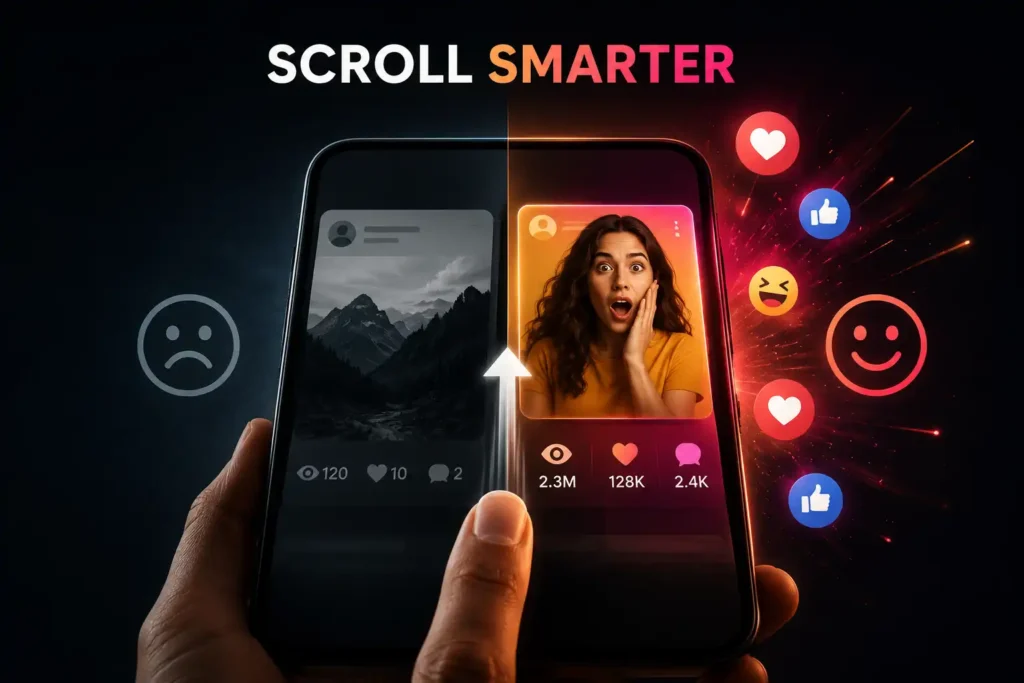
The algorithm does not know if your content is good. It has no mechanism for evaluating quality in any meaningful sense. What it can measure, and what it rewards, is response. Did people stop? Did they watch it again? Did they send it to someone? Did they comment something? Did they save it?
Response is the metric. And the only thing that reliably produces response is emotion.
Not just any emotion though, and this is where most brand content quietly fails.
The emotions that brands tend to chase are what you might call soft emotions. Warmth. Mild inspiration. The gentle feeling of “that is nice.” These are not bad emotions but they are weak activators. They produce a pleasant sensation that dissolves almost immediately and almost never compels anyone to actually do anything.
The emotions that produce action are the sharp ones. Genuine surprise. Anger that feels justified. Recognition so accurate it is almost uncomfortable. Humor that arrives when you are not expecting it. Vulnerability that makes you feel less weird about your own life. These emotions create a physical response, something in the chest or the stomach, something involuntary, and that physical sensation is what pulls someone out of passive scrolling and into genuine engagement.
Think about the last time you sent something to a friend. A video, a post, a screenshot of a caption. What did that content make you feel? Almost certainly not “mildly pleasant.” More likely something sharper. “This is literally my life.” Or “you need to see this immediately.” Or “I cannot believe they actually said this out loud.”
That sharpness is what travels. The bakery video of burnt croissants traveled because tired people at the end of a hard day felt something real when they saw it. Not warmth. Recognition. The specific recognition of your own small disasters reflected back at you unexpectedly.
That is not a production quality. That is an emotional frequency.
Part Four: Timing Is Not About Posting Schedules
Every social media guide in existence will tell you about optimal posting windows. Post on Tuesday mornings. Avoid Friday evenings. Catch your audience during their lunch break. This advice is not wrong exactly but it is also not the real point.
There is a deeper kind of timing that matters far more and almost nobody talks about it properly.
Communities, audiences, groups of people, they move through emotional cycles together. There are weeks when a particular frustration is sitting just below the surface for a huge number of people at the same time. There are moments when a shared exhaustion or a shared excitement or a shared anxiety is right at the front of everyone’s experience. These moments are not always tied to news events or cultural moments. Sometimes they are just the collective mood of a specific group of people at a specific point in time.
When a piece of content arrives at exactly that moment and names what everyone is feeling but nobody has quite put into words yet, it spreads in a way that has nothing to do with production quality or posting time or hashtag strategy. It spreads because it is the right thing at the right emotional moment.
This is why some completely ordinary content occasionally gets extraordinary reach. It is not random. It is resonance. The content happened to be tuned to the exact frequency the audience was already broadcasting on.
You cannot engineer this perfectly and anyone who tells you otherwise is selling something. But you can get much better at it by genuinely paying attention to what your specific audience is actually feeling right now. Not what the analytics say they clicked on three months ago. Not what they say in surveys. What are they actually frustrated or excited or scared about this particular week? What is the thing everyone is experiencing but nobody has articulated cleanly yet?
The creators who consistently seem to catch these waves are not luckier or more talented than everyone else. They are more attuned. They are listening at a level that most content strategies never even attempt.
Part Five: The Honest Reason Most Content Gets Ignored
There is something worth being genuinely honest about here.
A lot of what the marketing world calls great content is great by the standards of people who make content for a living. It would perform well in a case study presentation. It would earn a nod in a creative review. The craft is real and the intention is good.
But the person who is going to encounter that content is not in a creative review. They are on their couch at eleven at night, half present, one eye on whatever is on television in the background, scrolling because they are tired but not quite ready to put the phone down. They are not going to stop for something that requires effort to appreciate. They are not going to lean forward for something that rewards careful attention.
Effective content does not ask the audience to meet it halfway. It reaches across the gap and pulls them in before they realize they have been pulled.
The difference between content that communicates and content that connects is almost never a question of design or budget or strategy. It is almost always a question of whether the person who made it genuinely understood what it felt like to be on the receiving end of it. Whether they could picture that specific person on that specific couch at that specific tired hour and make something that would reach them there.
The best content creators share this more than anything else. Not the best cameras or the biggest budgets or the most refined aesthetic. Just a genuine, personal, sometimes uncomfortable understanding of what their audience is actually going through. And the willingness to meet them there rather than where it would be more convenient or more flattering to meet them.
Conclusion
So what do you actually do with all of this?
Honestly, not a formula. There is no formula. If one existed and became widely known, everyone would use it, the brain would habituate to it within a month, and it would stop working completely.
What you do is change the question you ask before you post anything.
Stop asking “is this good?” and start asking “does this interrupt something? Does this land on a real feeling? Does this arrive at the right moment? Would the person I am actually trying to reach, tired and half distracted on a Wednesday evening, feel something real when they hit this?”
The burnt croissant video was not a strategy. But it had everything a strategy tries and mostly fails to manufacture. It was unexpected in a feed full of expected things. It was genuinely honest in a space that is mostly performance. And it arrived at the exact hour when tired people across the world were looking at their own small daily failures and feeling quietly less alone.
You cannot copy that moment. But you can build content with the same spirit underneath it. Less performance, more honesty. Less optimized for how it looks to other marketers, more built for how it lands with a real human being at the end of a real day.
The algorithm is not your audience. The person on the other side of the screen is. Everything that actually works starts from there.