
5 Powerful Digital Marketing Strategies That Actually Work
Introduction
Digital marketing has changed dramatically over the last few years. New platforms emerge, algorithms evolve, and consumer behavior shifts faster than ever. Strategies that delivered impressive results a few years ago may no longer have the same impact today. Yet, despite these constant changes, some marketing approaches continue to prove their value because they focus on what truly matters—understanding people and delivering value.
Many businesses make the mistake of chasing every new trend they see online. They spend time trying to go viral or copying what competitors are doing without understanding whether those tactics suit their audience. The result is often wasted time, money, and effort.
Successful digital marketing isn’t about doing everything. It’s about doing the right things consistently. Businesses that understand their customers, create meaningful content, optimize their online presence, and build genuine relationships are the ones that experience long-term growth.
Whether you’re a startup, a local business, a freelancer, or an established company, the right digital marketing strategy can help you increase visibility, attract qualified leads, and convert visitors into loyal customers.
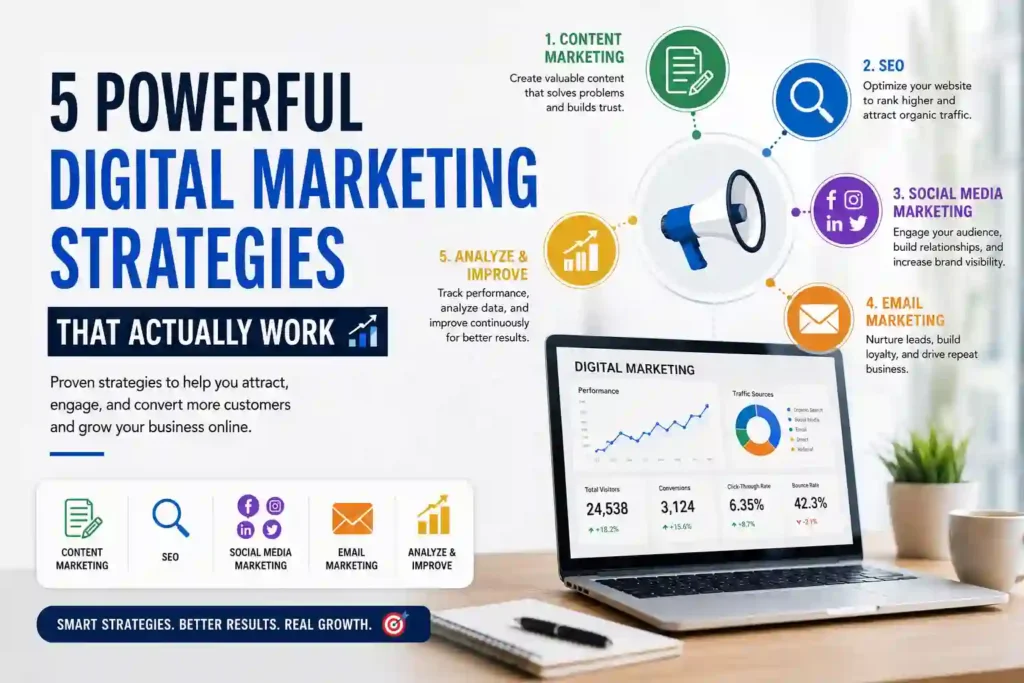
Here are five digital marketing strategies that continue to deliver real results across industries.
1. Create Content That Solves Real Problems
Content remains one of the strongest tools in digital marketing, but only when it serves a purpose. Publishing articles or videos simply to maintain a posting schedule rarely creates meaningful engagement. Instead, successful brands focus on answering questions, solving problems, and educating their audience.
Before creating any piece of content, ask yourself a simple question: What will someone gain after reading or watching this?
People search online because they need information. They want solutions, comparisons, guides, recommendations, or inspiration. When your content provides exactly what they’re looking for, trust begins to develop naturally.
Different formats can be equally effective depending on your audience. Blog posts help answer detailed questions, videos simplify complex topics, infographics present data visually, and case studies demonstrate real-world success.
Consistency also matters. Publishing valuable content regularly signals both to your audience and search engines that your website is active and reliable.
Remember, quality always outweighs quantity. One well-researched article that genuinely helps readers often performs better than several rushed posts with little value.
2. Invest in Search Engine Optimization (SEO)
Even the best website cannot generate results if people cannot find it.
Search Engine Optimization, commonly known as SEO, improves your website’s visibility in search engine results. When someone searches for products or services related to your business, SEO increases the likelihood of your website appearing in front of potential customers.
Effective SEO starts with understanding what your audience is searching for. Keyword research helps identify the phrases people use, allowing you to create content that matches their intent.
However, SEO is no longer just about keywords. Search engines now evaluate the overall quality of a website. Factors such as page speed, mobile responsiveness, clear navigation, internal linking, and high-quality content all contribute to better rankings.
Building credibility through backlinks from reputable websites also strengthens your online authority. At the same time, regularly updating older content ensures that your website remains relevant as information changes.
SEO is not an overnight strategy. Results often take time, but businesses that consistently invest in optimization benefit from a steady stream of organic traffic without relying entirely on paid advertising.
3. Build Relationships Through Social Media
Social media has evolved far beyond being a platform for sharing photos or company announcements. It has become one of the most effective channels for building relationships with customers.
Today’s audience values authenticity. They want to interact with brands that feel approachable, transparent, and responsive. Instead of constantly promoting products, successful businesses focus on creating conversations.
Sharing behind-the-scenes moments, customer success stories, educational tips, industry insights, and user-generated content makes a brand more relatable. Responding to comments and messages also demonstrates that the business values its community.
Every platform serves a different purpose. Professional audiences may be more active on LinkedIn, while visually driven businesses often perform well on Instagram. Short-form videos dominate platforms such as TikTok and YouTube Shorts, whereas Facebook remains valuable for local communities and groups.
Rather than trying to maintain a strong presence everywhere, businesses should identify where their audience spends the most time and concentrate their efforts there.
Consistency, interaction, and authenticity usually outperform aggressive promotion.
4. Use Email Marketing to Nurture Long-Term Customers
Despite the rise of new digital platforms, email marketing continues to deliver some of the highest returns on investment.
Unlike social media, where algorithms determine who sees your content, email allows businesses to communicate directly with subscribers who have already expressed interest in their products or services.
The key to successful email marketing is relevance.
Instead of sending generic promotional emails to everyone, businesses should segment their audience based on interests, purchase history, or engagement levels. Personalized messages are more likely to be opened, read, and acted upon.
Effective email campaigns include welcome sequences, educational newsletters, product recommendations, seasonal offers, and follow-up emails after purchases.
However, balance is important. Sending too many promotional emails can lead to unsubscribes, while sending valuable information consistently helps build trust over time.
A well-maintained email list becomes one of the most valuable digital assets a business can own because it enables direct communication with existing and potential customers.
5. Measure Performance and Improve Continuously
One of the greatest advantages of digital marketing is that almost everything can be measured.
Unlike traditional advertising, digital campaigns provide detailed insights into how users interact with your content. Businesses can track website traffic, conversion rates, click-through rates, engagement levels, bounce rates, and customer acquisition costs.
These numbers reveal what is working and what needs improvement.
For example, if a landing page receives significant traffic but few conversions, the issue may lie in the page design or call-to-action. If social media engagement is high but website visits remain low, adjusting the content strategy may produce better results.
Testing different headlines, images, layouts, email subject lines, and advertising creatives helps identify what resonates best with the audience.
Continuous improvement is more effective than expecting immediate perfection. Small adjustments based on real data often produce significant long-term results.
Businesses that regularly analyze performance are better equipped to adapt to changing customer preferences and market conditions.
Conclusion
Digital marketing success rarely comes from a single campaign or one viral social media post. It is built through consistent effort, thoughtful planning, and a genuine understanding of customer needs.
Creating valuable content, improving search visibility, engaging audiences on social media, nurturing relationships through email, and making data-driven decisions are strategies that continue to deliver measurable results across industries. While each tactic is effective on its own, their combined impact is far greater when they work together as part of a well-planned marketing strategy.
As digital platforms continue to evolve, businesses should remain flexible and willing to learn. Trends will change, technologies will advance, and consumer expectations will continue to grow. However, the core principles of providing value, building trust, and maintaining meaningful relationships will always remain relevant.
Businesses that focus on these fundamentals instead of chasing every new trend are more likely to achieve sustainable growth, stronger customer loyalty, and long-term success in the competitive digital marketplace.